The largest transfer of private wealth in Canadian history runs through an accountant
Two trillion dollars of business assets change hands this decade, and the tax planning that decides what survives the handoff sits with firms of fewer than five people. The work is described in files those firms already hold — last year’s return, an assessment in a folder, a share register — and nothing reads it, because their software is a document store and a time sheet. So the work is found at year end, after the window to act has closed, and billed by the hour. Numberyard reads the book instead. Built by a CPA, and deployed.
The product is built and deployed. It has no customers.
One founder. Shane Gordon built it and runs it as CEO and CFO, and holds it outright going into this round. The first two hires land at close — a CTO who owns the product and its security, and someone who owns going out and selling it — both salaried from month 1. The data room holds the risks as well as the case.
The market
A demographic event, not a software trend
Software categories come and go on fashion. This one is being created by the age of the people who own Canadian businesses, and it arrives on a schedule nobody can defer.
76% of small business owners intend to exit within the decade, and 9% have a formal succession plan. Every exit is a tax event — lifetime capital gains planning, estate freezes, holdco reorganizations, the intergenerational transfer rules. Almost none of it is planned for in advance.
Of the firms with employees, 74.9% have fewer than five people. One hundred and thirty-nine in the entire country have more than a hundred. This market is small firms, and small firms buy software because they cannot buy headcount.
Up from 8,030 in 2024, with assets under management going from $3.1T to $5.4T. Private wealth is professionalizing fast, and the structures it professionalizes into land on an accountant's desk before anyone else's.
Firms already know where the money is. They cannot charge for it.
Advisory is the profession’s most in-demand service and its lowest-margin one — 20–24%, below the 28% earned on individual return prep — because it is billed by the hour alongside compliance. The firms clearing profit margins of 31% or more are disproportionately the ones that price it as a product instead. The gap between those two numbers is not a market observation. It is a product that does not exist yet.
of growing firms say advisory revenue is outpacing compliance revenue.
of revenue at those firms now comes from advisory work.
are blocked from expanding it by a skills gap, and 47% by clients who will not pay hourly for it.
Sources: CFIB, Getting the Transition Right (business succession survey). Innovation, Science and Economic Development Canada, Canadian Industry Statistics, NAICS 5412 (2025 establishment counts). Deloitte Private, Defining the Family Office Landscape (2024). Thomson Reuters Institute, 2026 State of Tax Professionals Report.
The position
Compliance is the door. Planning is the business.
Bookkeeping, month-end and tax compliance are recurring, rules-driven and the most automatable work in the profession. They are also the work that puts a firm inside a client’s complete financial picture every single month.
That picture is where planning opportunities live — a holdco that should have been frozen, a capital gains exemption nobody multiplied, a compensation mix costing thirty thousand dollars a year in avoidable tax. Today they are found by whichever partner happened to look. The system already holds the data required to find them.
Numberyard surfaces the opportunity out of the client’s own numbers. The CPA exercises the judgment and signs it. That division is deliberate and it is not going to move: it is what makes the product defensible to a regulator and insurable to a firm.
The target is the small and mid-sized practice that does no audit work — the firms serving owner-operators, family-office functions and high-net-worth individuals, where the tax questions are hardest and the software is thinnest.
Shipped, not a roadmap
Deployed. And you can put a return through it yourself.
A firm portal, a client-facing portal under the firm’s own brand, and a Canadian tax engine that is genuinely hard to bolt on later. The claim that the software reads your book is the one claim nobody else in this category can answer, so it is the one you can check without talking to us: put a prior-year return through the reader and see what comes off it, with the page and line behind every figure. No signup, and nothing is stored.
Bulk migration
A firm's back book arrives as a zip of prior-year returns and is read into structure. A CPA approves every figure, and each one shows the page it came from.
Planning detection
Thirty-six deterministic rules over the facts migration just read — corporate, across years, personal, and trusts and estates. Every finding is traceable to a line on a filed return.
Meetings, with a line through them
A call becomes an action plan and a set of leads. A lead points at a rule and stops — it cannot become a finding. No consent row, no recording.
Multi-entity groups
Holdco and opco modelled as a structure rather than as unrelated files — the shape almost every owner-managed client is actually in, and what makes the rules see anything.
Canadian tax engine
GST/HST, CRA representative authorization, corporate tax estimates, CCA, GIFI mapping, instalments and deadlines computed from each entity's own fiscal year end.
The practice, and the client's view of it
Clients, entities, engagements, staffing, document requests and engagement letters — plus a branded portal every client of every firm logs into.
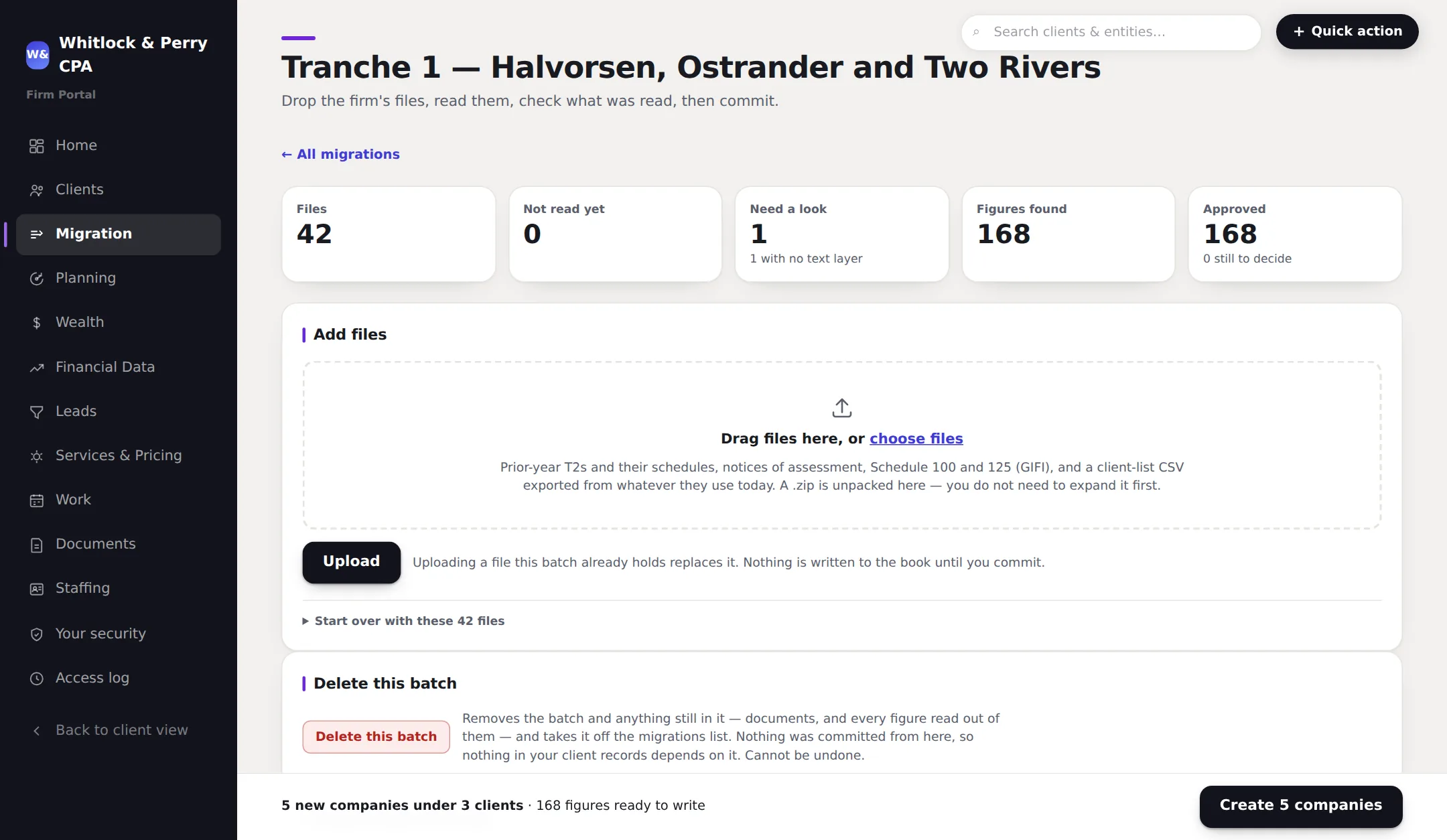
Migration — the wedge, and the screen no competitor advertises
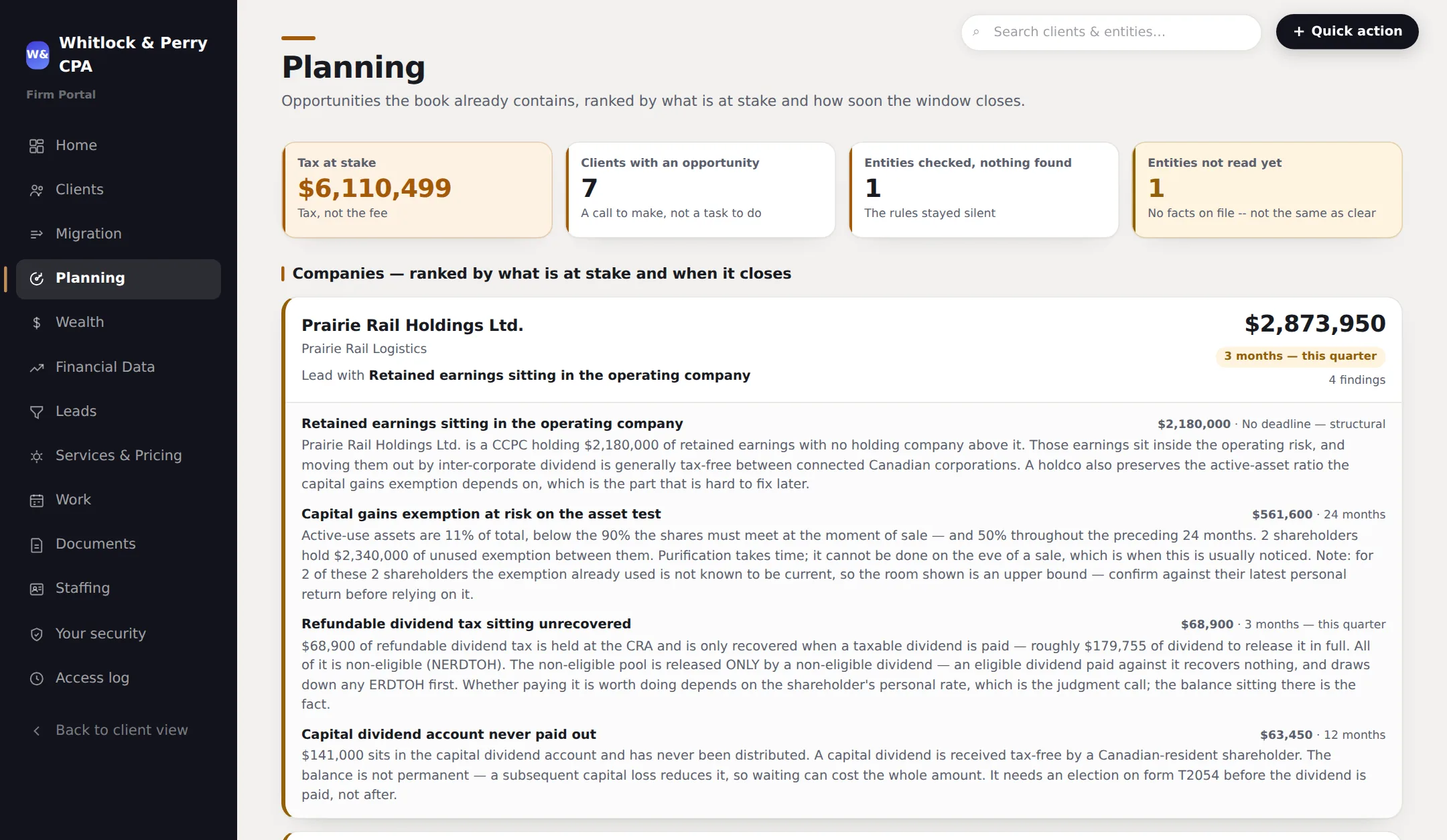
Planning — why the migrated data keeps earning
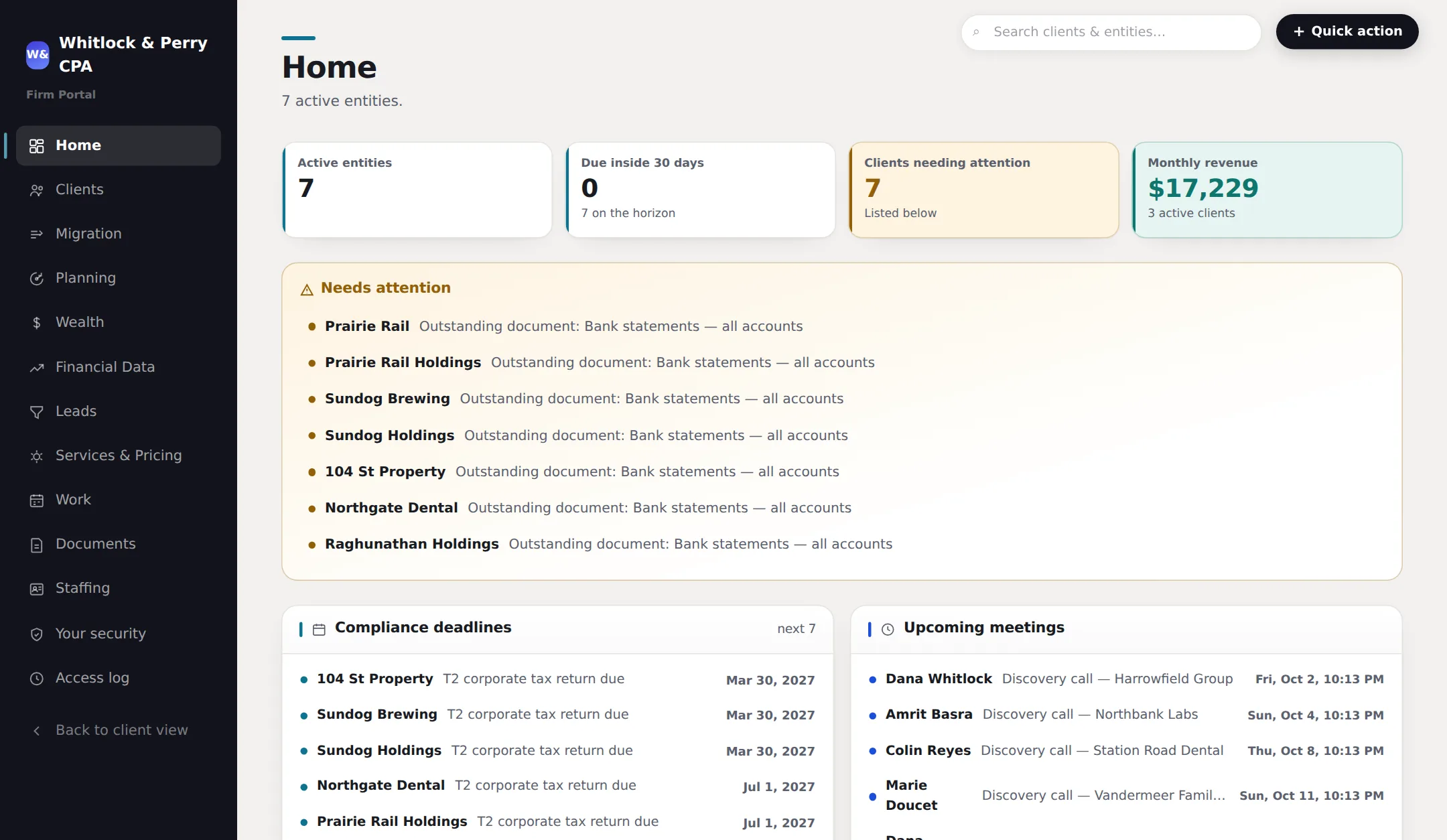
Firm Portal — the practice
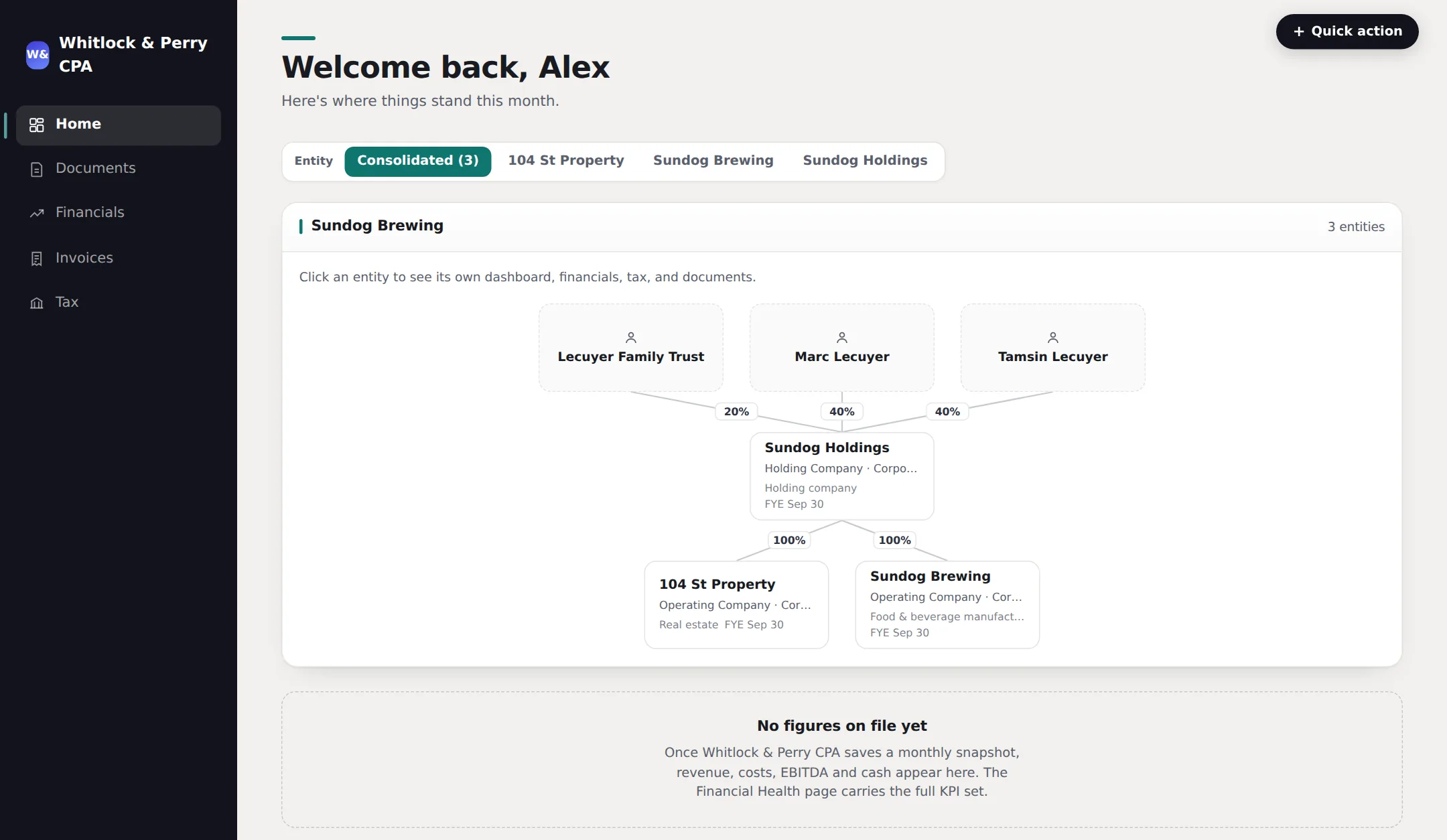
Client Portal — their clients
Screens from the running product on the demo firm — sample clients, real computation. Approved investors walk the same firm read-only from the data room.
The founder
One founder. The hard part is already done.
A deployed multi-tenant practice and client portal with the Canadian tax logic inside it: entity structures and share registers, migration that reads prior-year returns into structure, a planning engine that ranks findings by tax at stake and shows its work, and a wealth and projection engine. What is left is selling it, hardening it and supporting real firms — which is most of what turns this into a business.
Shane Gordon built it and runs it as CEO and CFO, full time, and holds it outright going into this round. A CPA who articled at a Big Four firm, ran finance functions from pre-revenue through private-equity-backed and NYSE-listed companies, one prior software exit, fourteen years of month-end closes, most recently compressing one from fourteen days to two and a half. That experience is what the planning engine encodes, and it is not a thing that can be encoded secondhand.
Most people who understand this problem cannot build software. Most people who can build software have never closed a month, and have never read the Income Tax Act. The half that needed both is done.
The data room
Request access
The deck, the five-year model, the business plan and the security gap assessment — plus a read-only walkthrough of the live product — are released after a short confidentiality agreement. We’re talking to a small number of people before any of this is public.
Already approved? Sign in.